Adam Brooks
May 22, 2025
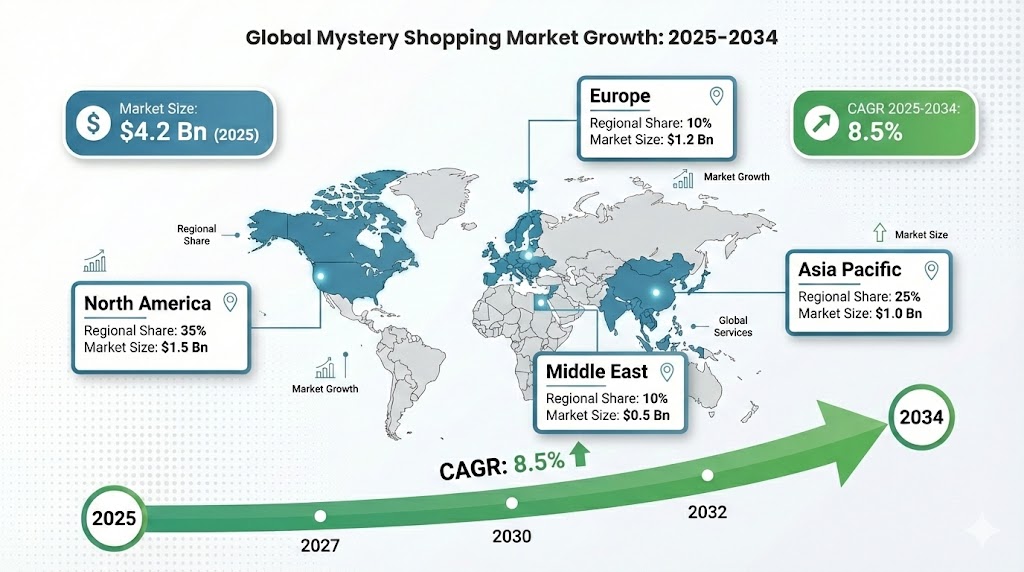
Mystery shopping has evolved from a basic audit tool into a strategic performance management system delivering measurable ROI. The global mystery shopping market, valued at $2.31 billion in 2025 and projected to reach $3.61 billion by 2034, reflects its proven impact. Organizations deploying structured mystery shopping programs report 12-15% customer satisfaction improvements within six months, 20% employee compliance gains, and 10-18% sales conversion increases. For UAE businesses, this systematic approach addresses five core areas: unbiased feedback, operational visibility, competitive intelligence, employee development, and brand consistency.
Market Context
North America dominates with 43.89% market share ($1.02 billion), Europe holds 25.31% ($585 million), and Asia-Pacific (fastest-growing) accounts for 18.01% ($416 million). The market exhibits 5.12% CAGR, reaching $3.61 billion by 2034.
In-person mystery shopping maintains 33.47% of 2026 market share, while online mystery shopping (website evaluations, chatbot interactions, digital assessments) expands at 6.16% CAGR. This reflects customer expectations for seamless experiences across physical stores, websites, mobile apps, and social channels.
Five Core Performance Mechanisms
1. Unbiased Customer Experience Feedback
Mystery shoppers experience your business exactly as customers do, creating "the unfiltered mirror" that reveals gaps between brand promise and execution. Research shows 80% of businesses believe they deliver superior experiences, yet only 8% of customers agree. Mystery shopping closes this perception gap by documenting actual point-of-service behavior: greeting warmth, product knowledge, checkout efficiency.
Aggregated data across locations and time periods reveals patterns single channels miss, from best practices to replicate to recurring issues needing immediate attention.
2. Operational Visibility and Efficiency
Mystery shopping acts as an operational X-ray. A QSR chain evaluating drive-thru operations identified order-taking bottlenecks, reduced wait times by 10%, and achieved 8% sales increases within six months. A clothing retailer fixed navigation and display issues, improving service quality 25% while boosting staff motivation through performance-linked incentives.
McKinsey research shows operational efficiency improvements lift profitability up to 30%. Mystery shopping data pinpoints highest-leverage opportunities for strategic resource allocation.
3. Brand Consistency Across Locations
For multi-location operations, inconsistency damages the entire brand. Mystery shopping programs enforce standards through systematic documentation. A 15-location restaurant chain with inconsistent food quality used mystery audits to identify execution gaps. Post-audit training improved consistency and customer ratings.
Customers experiencing consistent quality across locations develop stronger loyalty and recommendation behaviors, turning franchise structural advantages into competitive reality.
4. Employee Development and Accountability
Mystery shopping enables precise, targeted training. A retail brand investing heavily in training but receiving poor reviews discovered employees followed procedures but lacked warmth. A focused mystery shopping employee training program addressing behavioral gaps increased satisfaction 20% within weeks.
Research shows mystery shopping evaluations drive up to 20% compliance improvement. Recognition programs tied to results amplify positive behaviors. Engaged employees are 17% more productive (Gallup), directly impacting operational performance.
5. Competitive Intelligence
Mystery shopping systematizes competitive reconnaissance. A financial services firm deployed shoppers to nine competing lenders, documenting loan application experiences. The comprehensive comparison informed their digital redesign.
Retailers assess competitor merchandising, layouts, promotions, and service. Longitudinal data reveals trends: service quality gains, process efficiency improvements, training investments. This moves competitive assessment from speculation to documented strategy.
Quantified Business Impact
Revenue Drivers: Organizations report 10-18% sales conversion improvements after addressing barriers identified through mystery shopping. When mystery shopping reveals inconsistent upselling, fixing this gap increases upsells 20%, often exceeding program costs.
A casino operator improved staff efficiency and guest engagement, achieving 20% loyalty signup increases and 12% repeat visit growth.
Customer Retention: Bain & Company shows 5% retention increases boost profits 25-95%. A restaurant chain's mystery shopping program increased satisfaction 15% over one year, driving higher repeat visits and revenue.
Cost Reduction: Process optimization based on customer journey data reduces labor per transaction while improving experience. Mystery shopping identifies unnecessary steps, reducing costs without degrading service.
Technology Integration
AI-augmented mystery shopping addresses human observation accuracy (averaging 71%). Modern platforms integrate: human observations, AI sentiment analysis, speech analytics, computer vision for display compliance, and facial recognition for engagement assessment.
AI processes vast data rapidly, clustering locations by service quality and enabling prioritized resource deployment. Omnichannel evaluation ensures consistency across in-store, website, mobile app, chatbot, email, and social media touchpoints.
Implementation Framework
Measurable Goals: "Reduce checkout wait below 3 minutes at 95% of evaluations," "Achieve 90% greeting protocol compliance."
Experienced Partners: Third-party agencies provide expertise, shopper networks (IntelliShop operates 1 million+ shoppers), and benchmarking data.
Comprehensive Criteria: Combine objective observations (greeting within 30 seconds: yes/no) and subjective assessments (warmth: 1-5 scale).
Frequency: Monthly or quarterly evaluations reveal trends. Occasional audits only provide snapshots.
Operational Integration: Link findings to training curricula, performance bonuses, SOP refinements, and strategy discussions.
Combined Data: Integrate with NPS surveys, satisfaction scores, online reviews, social sentiment, and transactional data.
Cost-Benefit Economics
Individual evaluations: $20 (phone calls) to $300+ (comprehensive multi-hour assessments). A 100-location monthly program costs $20,000-$30,000 plus analytics.
ROI example: A $10 million revenue business with 20% margin seeing 2% conversion improvement generates $200,000 incremental gross profit, justifying $50,000-$100,000 annual investment. Restaurant chains seeing 8% sales increases realize ROI within months.
Risk Management
Primary risk: collecting data without action. Mystery shopping requires organizational commitment. Secondary risk: over-reliance on single evaluations. Robust programs use frequency and aggregation to distinguish patterns from outliers. Data quality demands clear criteria, trained evaluators, and bias-minimized reporting.
Conclusion
Mystery shopping delivers 12-15% satisfaction improvements, 20% compliance gains, 10-18% conversion increases, and 30% efficiency improvements. For UAE businesses in retail, hospitality, banking, healthcare, or professional services, mystery shopping represents high-ROI investment in systematic performance management.
Sophisticated operators integrate mystery shopping into comprehensive CX strategies combining human evaluation with AI analytics, spanning omnichannel touchpoints, benchmarking competitors, and linking findings to employee development. As customer experience differentiates competitive positioning in the UAE market, mystery shopping's strategic importance continues deepening.